
USA at the 2026 World Cup — Host Nation Hype or Genuine Contenders?
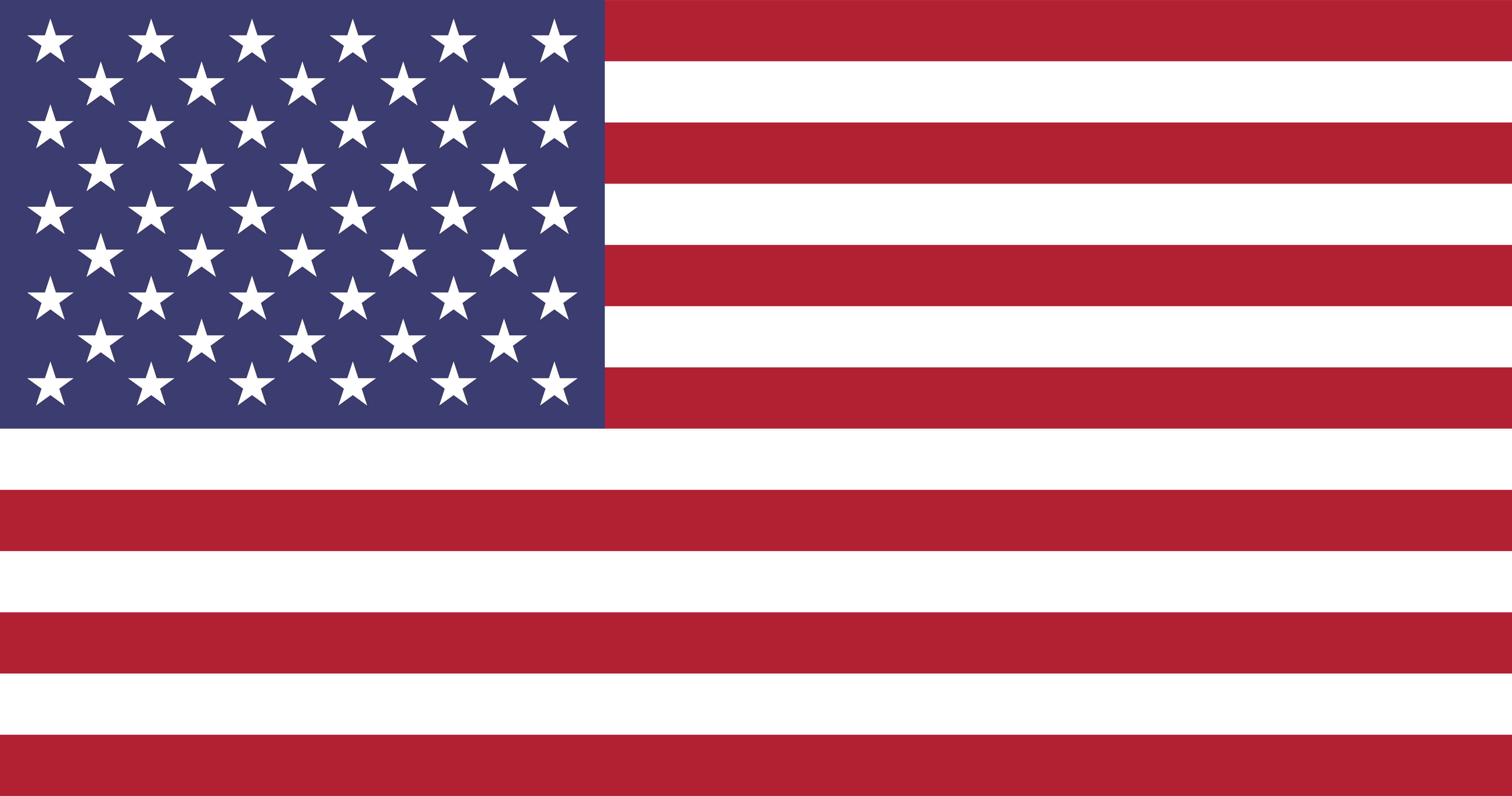 Available in US
South Korea reached the semi-finals in 2002. Germany reached the semi-finals in 2006. Brazil reached the semi-finals in 2014. Russia reached the quarter-finals in 2018. Qatar went out in the group stage in 2022. The host-nation record at World Cups varies wildly, and the pattern — if there is one — suggests that the home advantage matters only when the squad has genuine quality to begin with. The USA at the 2026 World Cup have the crowd, the stadiums, and the infrastructure. The question that matters for punters is whether they have the players.
The USMNT land in Group D alongside Paraguay, Australia, and Turkey. It is a group designed by the draw to give the hosts a realistic path to the Round of 32, and anything less than first place would be considered a failure by the American public and media. For Irish punters looking at the host-nation angle, the USA present an intriguing proposition: a side with enough talent to make noise, enough support to turn every match into a home fixture, and enough uncertainty about their true level to create mispricing in the odds.
The Host-Nation Advantage — Myth or Market Mover?
The host-nation advantage in football is real but overstated. I went through the data for every World Cup since 1990 and found that host nations win roughly sixty-two percent of their group-stage matches, compared to a baseline of around forty-five percent for non-hosts of equivalent FIFA ranking. That boost — roughly seventeen percentage points — is significant but not transformative. It means the hosts are more likely to win matches they would already be favoured in, and marginally more competitive in matches where they are underdogs. It does not mean they suddenly become contenders against elite sides.
For the USA specifically, the advantage is amplified by the sheer scale of the tournament infrastructure. Seventy-eight of the 104 matches will be played in American stadiums, meaning the USMNT will never leave the country during the tournament. The travel distances between venues are large by European standards but manageable for a side accustomed to American geography. The crowd support will be overwhelming — American sports fans generate an atmosphere that, in enclosed stadiums with retractable roofs, creates a noise level that can genuinely disrupt opposition communication.
The time-zone advantage is another factor. Every match kicks off at a time that suits American body clocks, while European and Asian sides will be adjusting to jet lag, unfamiliar climates, and training schedules disrupted by long-haul travel. For Irish punters watching from home, the flip side of this advantage is that most matches involving the USA will kick off at times that translate to late evening or night in Ireland — the 18:00 ET and 21:00 ET slots become 23:00 and 02:00 IST respectively.
The host-nation factor translates directly into odds. The USA are priced around 20/1 for the outright — shorter than their FIFA ranking and squad quality alone would justify. That premium represents the market’s estimate of the home advantage, and the question for bettors is whether the premium is too large, about right, or insufficient. My view: it is about right. The host advantage adds two to three percentage points to the USA’s base probability, and the current price reflects that adjustment. There is no significant mispricing in either direction.
Squad Depth and European Experience
The current USMNT squad is the most European-experienced in American football history. Christian Pulisic at AC Milan, Weston McKennie at Juventus, Tyler Adams in the Premier League, Gio Reyna at Borussia Dortmund — the core of the squad plays in leagues that demand tactical sophistication, physical intensity, and mental resilience week after week. That European exposure is a meaningful upgrade from previous American World Cup squads, which relied more heavily on MLS-based players whose club experience did not prepare them for the intensity of knockout football against elite sides.
Pulisic is the talisman. His output at Milan — goals, assists, and progressive carries per ninety — is among the best of any attacking midfielder in Serie A, and his ability to produce in big moments has been proven at Champions League level. His fitness is the concern: he has a history of picking up muscular injuries at inconvenient moments, and a World Cup schedule that demands peak physical performance every three to four days will test his body. If Pulisic is fit for the duration, the USA have a genuinely dangerous attacking player. If he misses even one knockout match, the creative output drops significantly.
McKennie provides the midfield engine — a box-to-box presence who covers ground, wins duels, and contributes in both boxes. His understanding of Italian tactical football translates well to the international game, where positional discipline and the ability to read defensive structures are essential. Around McKennie and Pulisic, the supporting cast is young and talented but relatively inexperienced at the highest level. Several key players will be playing in their first World Cup, and the step up in intensity from CONCACAF qualifying to World Cup knockout football is the kind of adjustment that some players make immediately and others never make at all.
The defensive unit is the area of greatest concern. The centre-back options are capable at club level but lack the composure under pressure that the tournament’s best defensive pairings provide. The goalkeeping situation is settled, and the starter brings enough quality to compete, but the defence as a whole does not inspire the confidence that a deep tournament run requires. Against Turkey’s attacking quality or a potential Round of 32 opponent from Europe or South America, the back line will be tested in ways that CONCACAF qualifying did not prepare them for.
Group D — Paraguay, Australia, Turkey
Group D is a group the USA should win, but “should” is a dangerous word in World Cup football. Paraguay are South America’s most pragmatic side — disciplined, physical, and capable of grinding out results against technically superior opponents. Australia bring a similar profile: organised, hard-working, and dangerous from set pieces. Turkey, who qualified through the UEFA playoffs, are the most talented of the three opponents — a side with Premier League and Bundesliga-calibre players who can compete with any mid-tier European side on their day.
The USA-Turkey match is the group’s standout fixture. Turkey’s pressing intensity and transition speed will test the American defence, and the crowd advantage — while real — will not prevent Turkey from creating chances if the USA’s back line is caught high. This match has the profile of a tight, tactical contest decided by a single goal, and the result will likely determine whether the USA finish first or second in the group.
Paraguay and Australia are both beatable but neither is easy. Both sides will defend deep, invite pressure, and look to hit on the counter — a style that has historically caused the USA problems because their build-up play under pressure is not yet at the level of Europe’s top sides. The key for the USA in both fixtures is patience: the goals will come if they maintain possession and probe intelligently rather than forcing the issue with direct, imprecise long balls.
My projected finish: USA first, Turkey second, Australia third, Paraguay fourth. The Group D winner market prices the USA around 4/7, which feels about right. The value play is Turkey to qualify — priced around 5/4, which underestimates their squad quality and European competitive experience.
Odds Verdict — Home Premium Baked In?
At 20/1, the USA are priced as a third-tier contender — behind the traditional European and South American powerhouses but ahead of sides like Japan, Morocco, and Colombia. That positioning reflects the host advantage more than the squad quality. Strip away the home factor and the USA would sit closer to 33/1 or 40/1, which is where their squad alone would place them.
I think 20/1 is close to fair value — perhaps marginally short, meaning the host premium is slightly overpriced. The realistic ceiling for this squad is a quarter-final appearance. To go further, they would need to beat a side like France, Spain, or Brazil in a knockout match, and the evidence from recent tournaments suggests the USA are not yet at that level. The gap is closing — each new generation of American players is more technically proficient and more tactically aware than the last — but closing is not the same as closed.
Where I see value: USA to reach the quarter-finals at around 5/2. This requires winning the group and then winning a Round of 32 match — both achievable outcomes given the group draw and the likely knockout-round opponent. The 5/2 price implies a probability of around twenty-eight percent, which I think is slightly below the USA’s true probability of reaching the last eight when the host advantage is factored in. It is a bet that captures the upside of the home factor without requiring the USA to overcome elite opposition in later rounds.
The Insider Take
The USA at a home World Cup are an event as much as a football team. The stadiums will be packed, the atmosphere electric, and the media coverage intense in a way that no previous American football experience has matched. For Irish punters, the host-nation dynamic creates opportunities in live markets: the crowd will influence match momentum, and the in-play odds will react to that momentum in ways that can be exploited by bettors who understand the ebb and flow of American sporting events.
Back the USA to win the group if you want exposure. Back them to reach the quarter-finals if you want better value. And avoid the outright — 20/1 is not long enough for a side whose deep-tournament credentials remain unproven against elite opposition. The party will be brilliant. The football will be competitive. The betting value, though, lies in the short-to-medium range, not in the dreams of a final at MetLife Stadium.
