
SoFi Stadium — World Cup 2026 Venue in Los Angeles
 Available in US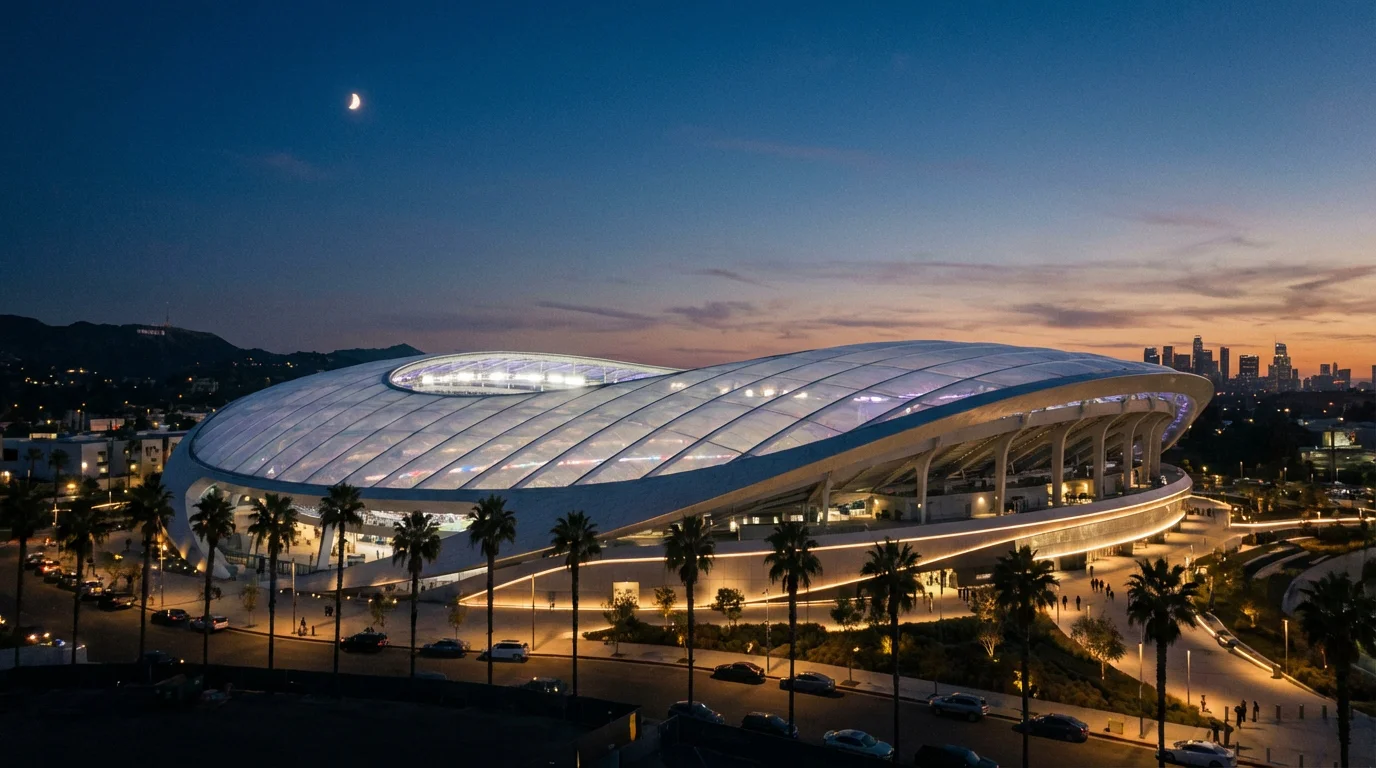
SoFi Stadium cost approximately $5.5 billion to build, making it the most expensive stadium ever constructed. That excess is visible in every detail — the translucent roof, the video board that wraps around the interior like a digital halo, the sheer scale of a venue designed to dwarf its occupants. For the 2026 World Cup, SoFi hosts some of the tournament’s highest-profile group-stage matches, including the USA’s opening fixture, and its characteristics create specific conditions that punters should understand before placing bets on any match played here.
Stadium Profile — Capacity, Surface, Conditions
SoFi Stadium sits in Inglewood, within the greater Los Angeles metropolitan area, and holds approximately 70,000 spectators in its football configuration. The venue’s defining architectural feature is its semi-enclosed canopy roof — not a true enclosed dome, but an ETFE (ethylene tetrafluoroethylene) covering that allows air circulation while providing shade from direct sunlight. That design is critical for World Cup matches played in the LA summer: the roof reduces the direct heat impact without creating the sealed, air-conditioned environment of a true indoor venue.
The pitch will be natural grass, temporarily installed for the tournament over the stadium’s usual synthetic surface. Los Angeles’ arid Mediterranean climate means the grass will require intensive irrigation, and the combination of artificial watering and the heat produced by the semi-enclosed roof structure could create a microclimate within the stadium that differs from the external conditions. In practice, this means the pitch may play slightly softer and slower than outdoor venues in the same temperature range — the moisture retention under the canopy is higher than in fully open-air stadiums.
Los Angeles in June and July typically delivers temperatures between 22 and 30 degrees Celsius with low humidity — a dry heat that is significantly more comfortable for athletes than the humid conditions at East Coast venues like MetLife and Hard Rock. The SoFi canopy reduces the heat further, making this one of the more player-friendly venues in the tournament. For betting purposes, that comfort translates to more consistent physical performances, fewer second-half collapses driven by heat exhaustion, and a lower probability of late goals caused by fatigue. The under 2.5 goals market at SoFi may be slightly more attractive than at humidity-affected venues where late defensive errors become more common.
World Cup 2026 Matches at SoFi
SoFi Stadium hosts the USA’s opening match — a fixture that will carry enormous domestic interest and generate deep betting markets. The USA versus Paraguay fixture sets the tone for the host nation’s campaign, and the SoFi crowd will be heavily partisan. For punters, the home atmosphere factor at SoFi is genuine but not overwhelming — the stadium’s vast scale can dilute crowd noise rather than concentrate it, and the acoustic properties of the canopy roof spread sound rather than focusing it toward the pitch. The players will hear the crowd, but it will not replicate the intensity of a compact European ground or the Estadio Azteca.
Additional group-stage matches at SoFi will feature teams drawn from multiple groups, and the venue’s LA location means significant diaspora support for Latin American, Asian, and European sides. A Mexico match at SoFi would produce a crowd composition comparable to the Azteca — Mexican-American fans in Los Angeles constitute one of the largest supporter bases for any national team at this World Cup. For live-betting purposes, the crowd energy at SoFi will vary dramatically depending on the fixture, and punters should assess the likely fan split before making in-play commitments.
For Irish viewers, SoFi’s Pacific time zone location means kick-offs at the venue will be later than East Coast matches. Expect most SoFi fixtures to translate to 01:00-04:00 IST — late-night and early-morning viewing that limits the appeal for casual fans but creates opportunities for dedicated punters. The live-betting markets at these hours will be thinner, with less European money active, and the spreads may widen slightly compared to prime-time East Coast fixtures. For disciplined bettors willing to trade at unsociable hours, that reduced liquidity can mean better entry points on specific markets.
The Venue Context — Climate and Betting Angles
SoFi’s dry-heat environment favours technical football. Low humidity means players can press and recover without the aerobic penalty that humid conditions impose, and the reduced physical stress allows midfield-dominated sides to maintain their passing tempo deeper into the second half. European sides accustomed to moderate climates will adapt more quickly to SoFi than to the humidity of Miami or the altitude of Mexico City, and that adaptation speed could influence early-round match outcomes. The dry air also affects the ball’s movement — dead balls travel slightly further and faster in low humidity, which benefits sides with strong set-piece delivery and long-range shooting capability.
The pitch surface is the variable to watch. Temporary grass in a semi-enclosed stadium with intense artificial lighting and limited natural airflow can behave unpredictably. If the turf holds up well through the group stage, SoFi will be one of the tournament’s best playing surfaces. If it deteriorates — as temporary installations sometimes do when exposed to sustained heat and heavy use — the matches later in the schedule will favour direct, physical football over the intricate passing game that the initial conditions might support. I recommend tracking pitch reports from the early SoFi fixtures before committing to bets on matches later in the tournament at this venue.
One specific betting angle that SoFi’s conditions create is the first-half over market. In the dry LA heat, teams tend to start aggressively before the cumulative physical toll becomes apparent. The first 30 minutes at SoFi are likely to produce higher-tempo, more open football than the same period at humid East Coast venues, and the first-half goals market should reflect that pattern. If it does not — if the bookmakers price SoFi first halves the same as MetLife or Hard Rock first halves — the discrepancy represents a tradeable edge.
Inglewood and the LA Football Landscape
Inglewood is a city within the Los Angeles metropolitan sprawl, situated south of downtown LA and adjacent to the LAX airport flight path. The stadium district has been purpose-built around SoFi, with new retail, dining, and entertainment facilities that were designed for exactly this kind of global event. Unlike MetLife’s suburban isolation, SoFi benefits from an urban setting with walkable amenities and a public transport infrastructure that, while imperfect by European standards, will handle the matchday footfall more effectively than most American venues.
The LA football audience is one of the most cosmopolitan in the world. The city’s immigrant communities mean that every World Cup nation will have visible fan support, and the pre-match atmosphere around the stadium will feel more like a Latin American or European matchday than a typical American sporting event. That cosmopolitan energy feeds into the betting markets — the crowd at SoFi will be loud, diverse, and engaged, which means the home-team advantage for the USA is real but not as dominant as it would be in a smaller, more insular city. For Latin American sides in particular, playing at SoFi may feel closer to a home fixture than an away one, and that comfort level could influence performances that the odds do not fully account for.
The Insider Note on West Coast Venues
West Coast World Cup venues present a unique challenge for European-based punters: the time zone works against you. Matches at SoFi kick off when the European trading session is winding down, which means the in-play betting markets are less liquid than for East Coast fixtures. For Irish punters willing to stay up late, that reduced liquidity is an opportunity rather than a problem — fewer market participants means wider spreads, but it also means less efficient pricing, and inefficient pricing is where sharp bettors find value. If you are going to bet on SoFi matches, do it live, do it late, and do it with a clear plan rather than reactive impulse.
